Hotline
Head Office
Head Office: Bypass Road, Jhilongja, Cox’s Bazar-4700, Bangladesh
Email Us


2026-03-13
Regional Advocacy Seminar on Localization in Bangladesh
From Commitment to Action: Advancing Quality Funding and Risk Sharing,”
PHALS Host a regional Seminar on Quality Funding and Risk Sharing in Humanitarian Response.
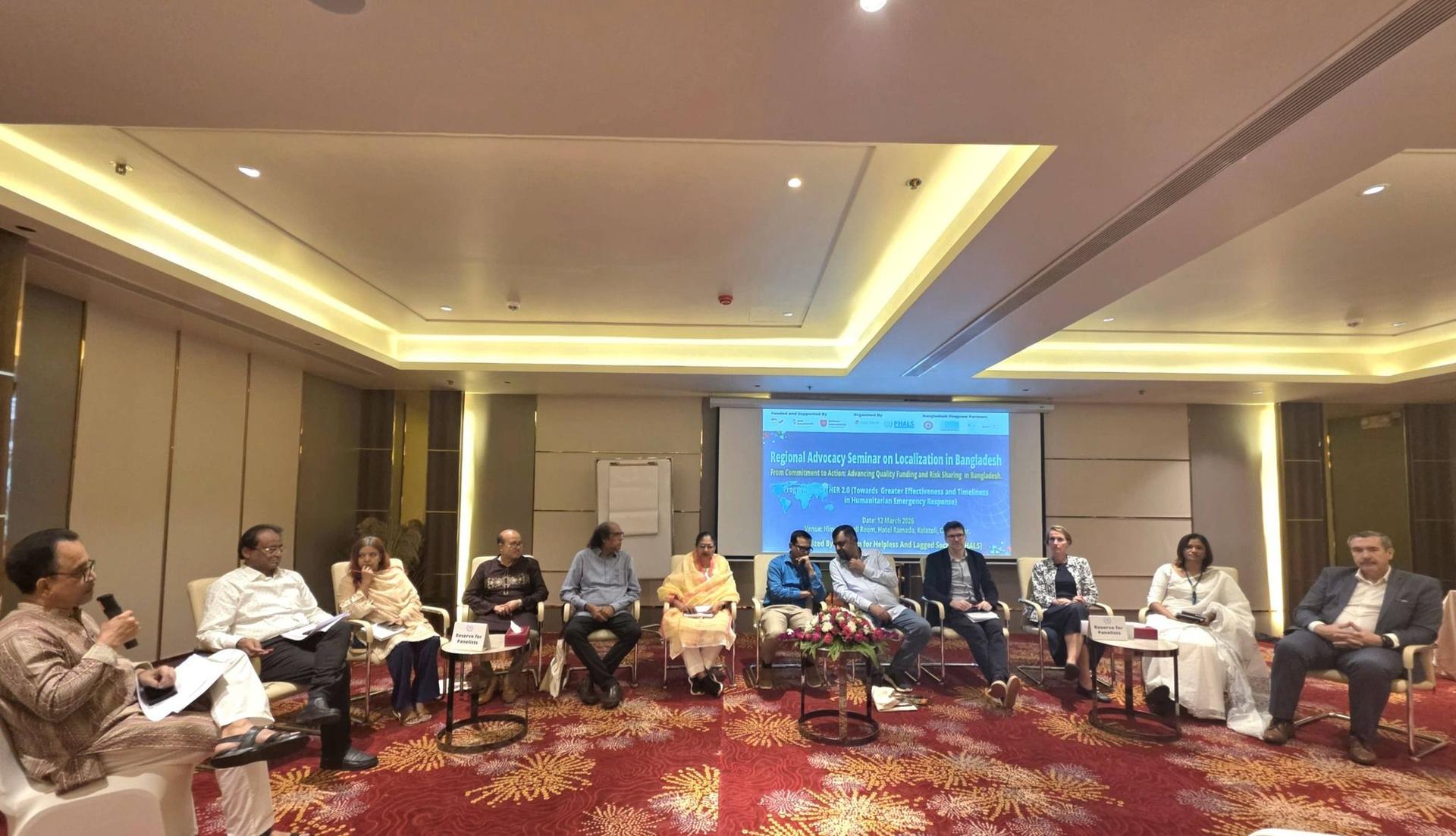
Cox’s Bazar, March 12: Seminar on quality funding and risk sharing in humanitarian response was held in Cox’s Bazar on Thursday at a local hotel conference hall, bringing together representatives from government offices, UN agencies, NGOs, civil society, and the media.
The seminar, titled “From Commitment to Action: Advancing Quality Funding and Risk Sharing,” was organized by local NGO PHALS under the Together Project, with overall support from Malteser International. The event focused on strengthening localization in humanitarian response.
The session began with a welcome address by PHALS’ voluntary Executive Director Abu Murshed Chowdhury, who highlighted the importance of equitable partnerships between international and local organizations.
During the seminar, Mohammad Arif Dewan, Coordinator of Malteser International Bangladesh, presented an overview of the Together Project’s ongoing activities across eight countries, including Bangladesh. The keynote paper was presented by Rashedul Hasan, Project Coordinator at PHALS.
A plenary session on quality funding, risk sharing, and localization followed, moderated by Abu Murshed Chowdhury.
The panel discussion included Md. Shariful Islam, Deputy Secretary and representative of the RRRC Office; A.K.M. Morshed, Senior Director of BRAC; Shishir Dutta, Executive Director of BETA; Kirti, Country Director of Malteser International; David Bugdan, Principal Coordinator of ISCG; Bimal Chandra De Sarkar, CEO of Mukti Cox’s Bazar; Astrid, UNHCR representative; Marko Miljevic, Coordinator of NGO Platform; Shiuli Sharma, Executive Director of Jenas; Zobaida Akhter, Head of Field Office at Oxfam; and Md. Mujibur Rahman, Advisor to Sushilon.
Among others present were Mahbubur Rahman, President of Cox’s Bazar Press Club; Advocate Romij Ahmed, Secretary of Cox’s Bazar Civil Society; Advocate Abdus Shukkur, along with representatives from various local, national, and international organizations.
Speakers emphasized that during humanitarian crises, local organizations and community actors are often the first responders and continue supporting affected communities long after international agencies leave.
However, participants noted that despite global commitments to localization, direct funding for local organizations remains limited, with most resources channeled through international agencies, causing delays and increasing administrative costs.
They recommended increasing direct and flexible funding for local organizations, establishing multi-year funding mechanisms, covering administrative costs, creating special funding pools for local initiatives, and developing equitable risk-sharing policies among governments, donors, and international organizations.
In his remarks, Abu Murshed Chowdhury said humanitarian responses have historically followed a “risk transfer model,” where financial and compliance risks are often shifted to local NGOs. He stressed the need for a balanced approach based on trust, shared responsibility, and mutual accountability.
The seminar concluded with Board of thank by Shishir Dutta, Executive Director of BETA